

CHIETAL | Meditation, Mind, and Neuroscience
Your body is sitting in a quiet room. Your mind is arguing with someone who is not there. What is your brain doing while you try to meditate?
An Everyday Story


Imagine a worker arriving home after a difficult meeting. A manager’s comment keeps repeating: “This needs improvement.” While a family member describes their day, the worker is mentally defending the project. They nod, but they have stopped listening.
During a short meditation that evening, the same scene appears again. This time the worker notices the replay and silently labels it “remembering.” They return attention to the sensation of breathing, then notice the scene return. The practice consists of those repeated shifts.
The next morning, the worker writes down one useful piece of feedback and one question for the manager. At dinner that night, they put the phone aside and ask their family member to finish yesterday’s story. This is an illustrative example, not a research participant’s testimony. It connects a scientific question about attention with a behavior someone can actually observe.
What is meditation from a neuroscience perspective?

Meditation is a collection of practices designed to train attention, awareness, and sometimes emotional responses. One widely studied approach is mindfulness meditation, which involves paying attention to present-moment experiences without immediately judging or reacting to them. For example, imagine you're sitting quietly when an uncomfortable thought appears. Instead of trying to eliminate the thought or becoming absorbed in it, you recognize that you're thinking and return your attention to your breathing. This practice involves attention and awareness.
Meditation doesn't require eliminating thoughts. It involves learning how to relate to them differently.
What areas of the brain are involved in meditation?
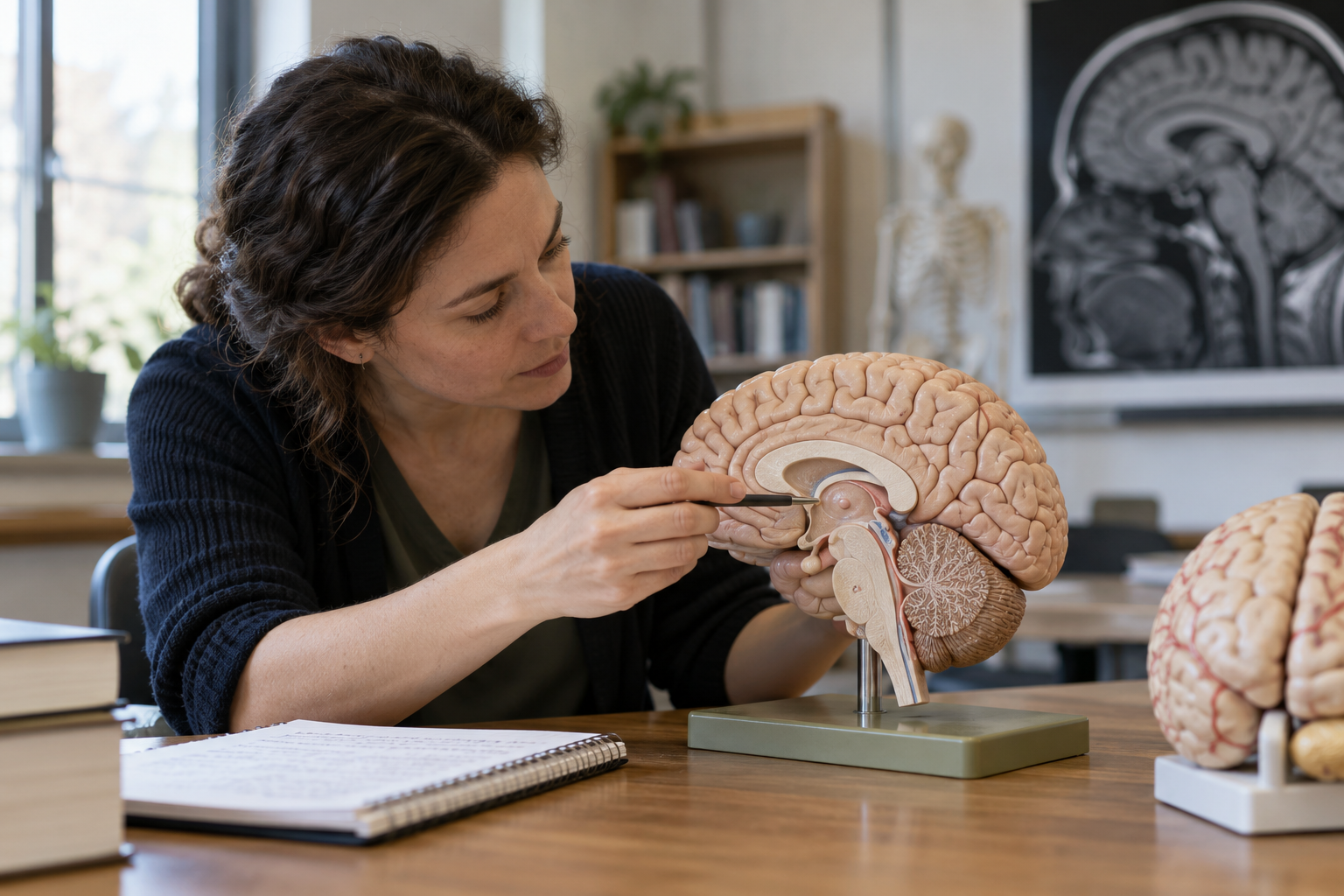
Meditation involves interactions among multiple brain networks rather than one isolated meditation center. Researchers commonly investigate the following regions.
Prefrontal cortex — planning and self-regulation. The prefrontal cortex contributes to attention, decision-making, and regulating behavior. Example: Choosing to return your attention to breathing instead of following a distracting thought involves cognitive control processes supported by prefrontal networks.
Anterior cingulate cortex — attention and monitoring. The anterior cingulate cortex participates in detecting conflicts and monitoring performance. Example: Recognizing that your attention has wandered can involve networks associated with monitoring and attention regulation.
Amygdala — emotional significance and threat processing. The amygdala helps evaluate emotionally significant information, including potential threats. Example: During an upsetting conversation, emotional responses involve the amygdala alongside many other brain systems.
Hippocampus — memory and learning. The hippocampus supports memory formation and is involved in learning-related processes. Example: Remembering and applying a calming strategy in a future situation depends on learning and memory systems. These regions work together within larger neural networks. Their involvement varies depending on the type of meditation and the person practicing. A scientific review by Tang, Hölzel, and Posner explores the neuroscience of mindfulness meditation: The Neuroscience of Mindfulness Meditation — Nature Reviews Neuroscience
What happens when your mind wanders during meditation?

One of the most common beginner experiences is mind-wandering. You begin focusing on your breath, but suddenly you're thinking about your responsibilities, memories, or future plans. This is normal. Researchers have investigated how different brain networks participate in this process. The default mode network (DMN) is a group of interconnected brain regions often active during internally directed thinking, including remembering the past, imagining the future, and thinking about yourself. The DMN is not inherently harmful. It supports important mental functions.
During certain meditation practices, researchers have observed changes in activity or connectivity involving the DMN and attention-related networks. For example, when you notice that you're lost in thought and return to your breath, you are practicing the transition from mind-wandering to intentional attention. A study by Brewer and colleagues investigated differences in default mode network activity among experienced meditators. Meditation Experience Is Associated with Differences in Default Mode Network Activity and Connectivity — PNAS
The important lesson is that getting distracted doesn't mean you're failing at meditation. Noticing the distraction and returning your attention is part of the practice itself.
How meditation may influence stress and emotional regulation

Stress is a natural physiological response to demands or perceived threats. When you experience stress, your brain and body coordinate changes involving attention, hormones, heart rate, breathing, and muscle tension. Meditation may help some people develop greater awareness of these responses and practice responding more intentionally. For example, imagine receiving an upsetting message. Your first impulse may be to reply immediately. But after practicing mindfulness regularly, you might notice your tension, pause, and decide how you want to respond.
This does not mean meditation eliminates anger, anxiety, or stress. It means the practice may help develop skills for recognizing and managing certain reactions. A systematic review and meta-analysis published in JAMA Internal Medicine found moderate evidence that mindfulness meditation programs can improve some measures of anxiety, depression, and pain, although effects varied and evidence for other outcomes was less clear. Meditation Programs for Psychological Stress and Well-being — JAMA Internal Medicine
Can meditation change your brain through neuroplasticity?

Neuroplasticity is the brain's ability to change its structure and function in response to experience, learning, and other biological influences. When you repeatedly practice a skill, neural networks involved in that skill may adapt. Meditation provides repeated opportunities to practice attention, awareness, and emotional regulation. Researchers have investigated whether long-term meditation practice is associated with changes in brain structure and function.
A 2022 study combining two randomized trials tested structural brain changes after eight weeks of mindfulness-based stress reduction. Among 218 participants who completed scans, it found no evidence of the structural effects tested relative to the comparison groups. This challenges simple promises of visible brain growth after a short program; it does not establish that meditation cannot affect behavior.
These findings are interesting, but they do not establish that meditation reliably increases brain tissue in everyone or produces a particular psychological outcome. The practical takeaway is that the brain can adapt through repeated experience—and meditation is one activity scientists are studying in that context.
What happens to your brainwaves during meditation?


Your brain produces rhythmic electrical patterns known as brainwaves. These patterns are measured in hertz (Hz), the number of cycles per second. Scientists group EEG rhythms into frequency bands, including delta, theta, alpha, beta, and gamma; the boundaries are approximate.
During meditation, researchers have sometimes observed changes in alpha and theta activity. However, the exact findings depend on the meditation technique, the participant's experience, and how researchers measure the signals. For example, closing your eyes can increase alpha activity even without meditation. This means an increase in alpha waves alone does not prove that someone has reached a special meditative state.
A systematic review examined EEG oscillations during mindfulness meditation and identified alpha and theta as commonly studied rhythms. A Systematic Review of the Neurophysiology of Mindfulness on EEG Oscillations
How EEG headbands fit into meditation. A wearable EEG device can record certain electrical signals while you meditate. Depending on the product and software, those signals may be converted into charts, numerical estimates, or audio feedback. This brings us to an emerging area of meditation technology: EEG-assisted biofeedback.
My Thoughts: The CHIETAL Perspective
I am interested in the relationship between the mind we experience privately and the choices we make publicly. The principle of Correspondence in The Kybalion offers a philosophical invitation to look for relationships across levels of experience. I use that idea as a question: how might my inner habits show up in my conversations and routines?
Science studies particular mechanisms and outcomes. It can investigate attention, behavior, or activity in a brain network. It does not establish the larger metaphysical claim that all levels of reality mirror one another.
My practical takeaway is to bring the two perspectives into an honest conversation. I can reflect on inner patterns while checking whether I am actually listening better, responding more thoughtfully, or following through. A meaningful interpretation should encourage responsibility and curiosity, rather than become a substitute for evidence.
The philosophical principles discussed here are presented in The Kybalion. They are interpretive lenses, rather than established laws of neuroscience.
If an exercise increases distress, stop or modify it. Meditation and consumer EEG feedback should not replace appropriate medical, psychological, or educational support. You can learn about benefits and limitations in the NIH overview of meditation.
Continue learning with How Meditation Changes Your Brain: The Practice Begins When Your Mind Wanders and Understanding Brainwaves: Alpha, Beta, Theta, Delta & Gamma.
Begin With the Free 7-Day Challenge
Bring this learning into everyday life. Subscribe to CHIETAL for the free 7-Day Brain & Mindfulness Challenge and more science-informed articles about attention, habits, and awareness. Seven days introduces a practice; it is not a deadline for changing your brain.