

CHIETAL | Meditation, Mind, and Neuroscience
You promise yourself that tomorrow will be different. Tomorrow arrives, the same trigger appears, and you repeat the habit. What actually gives change a chance?
An Everyday Story


Imagine someone who wants to stop scrolling after bedtime. Every morning they promise to be more disciplined. Every night they bring the phone to bed, see one notification, and lose another half hour.
One evening, they change the setup. The charger goes outside the bedroom. A book goes beside the bed. When the urge to check the phone appears, they notice it, read a page, and decide whether to continue. The first night feels awkward, and the second is not perfect.
After a missed night, they return to the arrangement instead of declaring the effort ruined. They also ask what made the evening harder: an urgent message, an unclear boundary, or simply forgetting the new plan.
This hypothetical story gives “change” something concrete to mean. There is a cue, an action, a practical adjustment, and a chance to learn. It does not require a promise that the brain will be permanently rewired by a particular date.
What is neuroplasticity?


Neuroplasticity is the nervous system's ability to change its structure, function, or connections in response to experience, learning, development, and injury. Your brain contains billions of specialized nerve cells called neurons. Neurons communicate with one another through connections called synapses. A synapse is a specialized junction where one neuron influences another, often using chemical messengers called neurotransmitters. When you learn something new, networks of neurons become involved in processing and remembering that information.
Conceptual overview: learning-related brain changes depend on the activity, feedback, repetition, and other factors. Neuroplasticity is not simply positive thinking. It is a biological property of the nervous system.
How does repetition change the brain?


When you repeat an activity, your brain repeatedly engages networks involved in that behavior. Over time, learning can change how efficiently those networks function. One important mechanism is synaptic plasticity—the ability of connections between neurons to become stronger or weaker. Scientists study processes such as long-term potentiation (LTP), a persistent increase in synaptic strength following particular patterns of neural activity. LTP is one mechanism associated with learning and memory, although human learning involves many biological processes. One everyday example is practicing an instrument.
Does repetition automatically create a habit? Not necessarily. Habit formation also depends on environmental cues, motivation, rewards, consistency, and context. Repeating a behavior can support learning, but simply repeating a positive phrase does not guarantee a new skill or lasting behavioral change. Effective practice combines repetition with clear actions, useful feedback, and opportunities to apply what you've learned.
Can meditation change the brain?

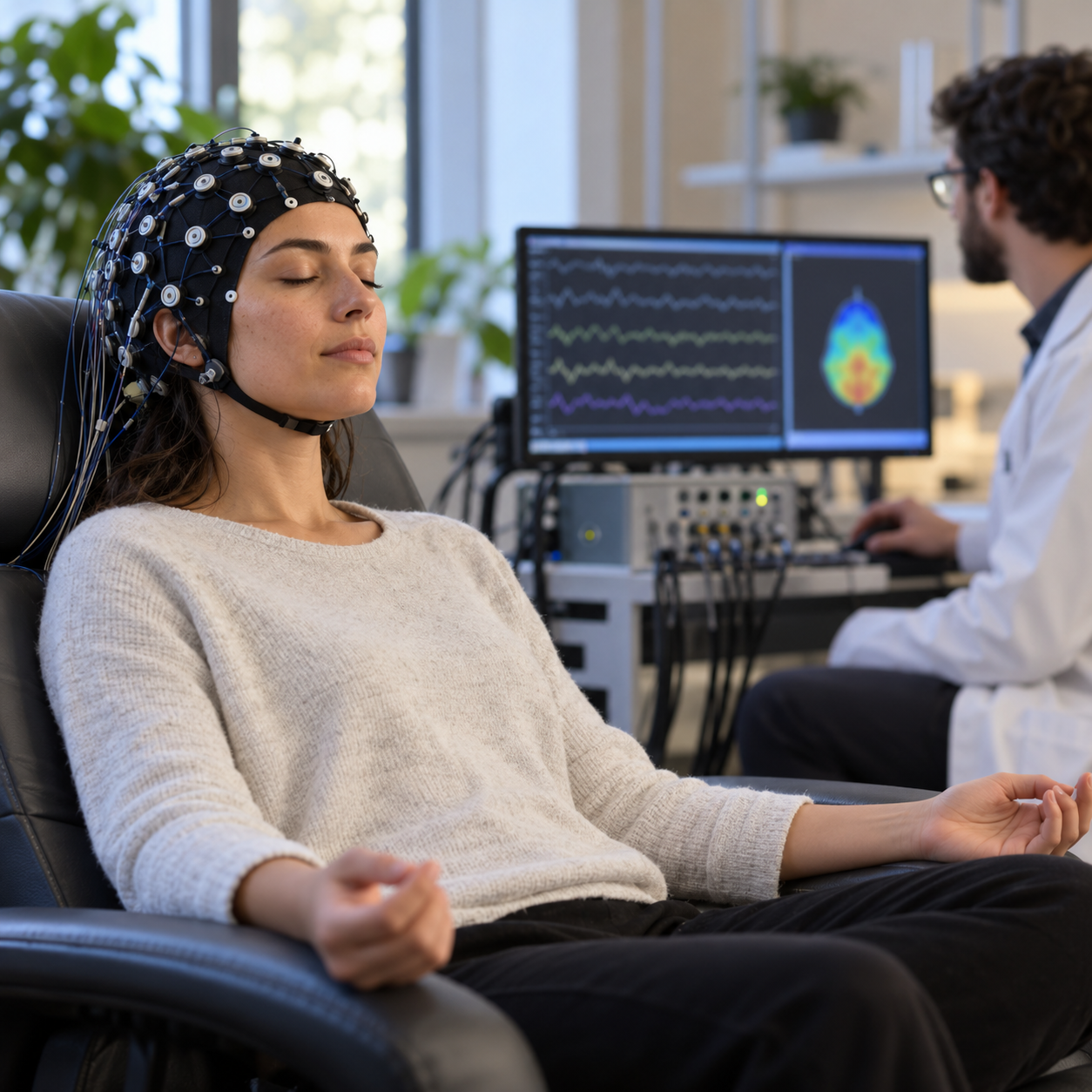
Meditation is one activity researchers have studied in relation to brain function and plasticity. During mindfulness meditation, people practice directing attention, noticing thoughts, and responding to experiences with awareness. These exercises engage cognitive processes related to attention and emotional regulation. Researchers have investigated whether repeated meditation practice is associated with changes in brain activity, connectivity, and structure.
What does this mean for beginners? You don't need to meditate for hours to begin practicing awareness. A short, manageable routine can help establish consistency. The important distinction is that practicing attention and demonstrating a measurable brain change are not the same thing. Meditation may support certain psychological skills, but claims about permanent brain rewiring require careful scientific evidence.
How thoughts, emotions, and behavior influence one another


Your thoughts, emotions, and behaviors influence one another. Imagine someone who automatically thinks, "I'm going to fail," whenever they encounter a difficult task. That thought may be accompanied by frustration or anxiety. The person might then avoid the task, reducing opportunities to practice and improve. Now imagine the person learns to recognize the thought and respond differently. Instead of immediately giving up, they think: This is difficult, but I can try one step at a time. They begin working, receive feedback, and gradually develop competence. The meaningful change is not simply replacing a negative sentence with a positive one.
This illustrates a possible behavioral shift, not a guarantee that every thought or emotional response can be changed through meditation.
How long does it take to change a habit?

Lally and colleagues studied everyday habit formation and found substantial variation in how quickly behaviors became more automatic. Their findings challenge the idea that everyone forms a habit on one fixed schedule. Seven days can introduce a routine, but it is not a scientifically established deadline for rewiring neural circuits.
How to make a new habit more consistent. Choose a small, specific behavior and connect it to an existing part of your routine. For example: After brushing my teeth in the morning, I will sit quietly and focus on my breathing for five minutes. The action is specific, manageable, and connected to a familiar cue. Track whether you complete the practice, but avoid treating a missed day as failure. The goal is to return to the routine and continue learning.
Can EEG biofeedback help us understand neuroplasticity?



Our article on meditation and EEG explains the difference between a recording and feedback. EEG measures electrical activity at the scalp. Feedback presents selected information from that recording during an exercise.
Likewise, an increase in an application's focus score does not establish that the brain has undergone a permanent beneficial change. EEG can help researchers investigate brain function, but neuroplasticity cannot be reduced to a single brainwave reading.
Visualization, mental rehearsal, and real-world change


Visualization involves deliberately imagining an experience, action, or possible outcome. For example, an athlete might mentally rehearse a movement before performing it. A student might imagine delivering a presentation before speaking in front of classmates. Mental rehearsal can support preparation in some circumstances, particularly when paired with physical or behavioral practice. However, imagining an outcome does not guarantee that it will happen.
Example: Becoming more confident when speaking. Imagine you want to become more comfortable speaking in front of others. You could visualize yourself standing confidently and delivering a presentation. But rather than stopping there, take practical steps. First, imagine a realistic challenge, such as forgetting what you planned to say. Rehearse pausing and continuing calmly. Then practice your presentation aloud, ask for feedback, and improve your delivery. By combining visualization with actual experience, you give yourself opportunities to learn and adjust. The purpose of mental rehearsal is to prepare for action—not replace action.
How Meditation, EEG, and Daily Habits Connect

Neuroplasticity helps explain how the nervous system can adapt through learning and experience. Throughout this article, we have seen how practice, feedback, and everyday routines can create opportunities for that learning. Meditation is one way to practice noticing where your attention goes and how you respond to thoughts and emotions. You might recognize a distraction, return to your breath, and then use that same awareness to approach a challenge more deliberately during your day.
Together, these ideas offer a grounded way to think about change: pay attention to your experience, practice a meaningful action, learn from feedback, and allow yourself time to grow.
My Thoughts: The CHIETAL Perspective
The principle of Cause and Effect in The Kybalion gives me a philosophical reason to examine the actions I repeat and the conditions around them. My practical interpretation is that intentions become more useful when I connect them with behavior, feedback, and an environment that supports the next step.
The principle of Polarity also invites me to reflect on moving along a range rather than dividing myself into “disciplined” or “undisciplined.” That is a metaphor for reflection, not a neuroscience explanation of habit formation.
Metaphysics can help me ask who I am becoming; science can investigate how learning and behavior change under particular conditions. I do not treat neuroplasticity as proof of manifestation or claim that thoughts alone guarantee an outcome. In the bedtime example, the meaningful shift is moving the charger and practicing another response. The philosophy becomes valuable to me when it encourages patient, practical action.
The philosophical principles discussed here are presented in The Kybalion. They are interpretive lenses, rather than established laws of neuroscience.
If an exercise increases distress, stop or modify it. Meditation and consumer EEG feedback should not replace appropriate medical, psychological, or educational support. You can learn about benefits and limitations in the NIH overview of meditation.
Continue learning with How Meditation Changes Your Brain: The Practice Begins When Your Mind Wanders and Meditation Meets Brain Technology: Can EEG Help Us Understand Our Minds?.
Begin With the Free 7-Day Challenge
Bring this learning into everyday life. Subscribe to CHIETAL for the free 7-Day Brain & Mindfulness Challenge and more science-informed articles about attention, habits, and awareness. Seven days introduces a practice; it is not a deadline for changing your brain.